
Introduction
In 2011, less than a year after purchasing my first home in Bend, Oregon, following two decades of renting, I found myself at a crossroads—a mix of nostalgia and excitement for new beginnings. As part of my move from Glendale, California, I decided it was time to finally empty out the storage unit I had set up back in 2008 when I relocated for a job in Southern California. Little did I know, this trip would reignite a passion that had been dormant for years.
Among the boxes of old memories and forgotten belongings were two treasures from my teenage years: my Tamiya Grasshopper and the beloved Tamiya Hotshot. Dusty, worn, and tucked away for over 20 years, these RC cars had once been at the center of my world. As I pulled them out of their storage, memories came rushing back, and I knew that this was the perfect time to bring them back to life.
This is the story of how unpacking those old RC cars led me down the path of restoring the Grasshopper and the Hotshot and diving back into the world of RC with a renewed sense of excitement and nostalgia.
The Decision to Return
After discovering my old Tamiya Grasshopper and Hotshot among the dusty boxes in my storage unit, I couldn’t help but think back to the days when RC cars were my passion. But as much as I loved those cars in my teenage years, life had pulled me in different directions. The thrill of motorcycles had taken over, but that chapter came to a sudden halt with an accident in the summer of 1986—just before my senior year of high school. It was a turning point that changed the course of my life in ways I wouldn’t fully grasp until much later.
Around the same time, another powerful force entered my life—girls. That led to an early marriage, the start of a family, and the intense responsibilities of adulthood. Between career moves, raising children, and the everyday demands of life, my RC cars were left behind, gathering dust in storage.
Fast forward to 2011, after purchasing my first home in Bend, Oregon. There’s something about settling into a new home that brings old memories to the surface. With a new sense of stability and the excitement of owning my own place, I began to think more and more about the hobbies and passions that once defined me. The trip to Utah to empty out my storage unit was more than just a practical task—it was a journey back to my roots.
When my oldest child offered to join me on the trip to Utah, it became clear that this was more than just a nostalgic journey. It was a chance to share a piece of my past with my family, to rediscover the things that once brought me so much joy. As we made our way through the boxes, my excitement grew with each old memory uncovered. But it was the sight of those two RC cars—the Grasshopper and the Hotshot—that truly reignited the spark.
This was more than just a trip down memory lane. It was the beginning of a new chapter, one where I would reconnect with the RC hobby that had been such an important part of my youth. The decision to return to RC wasn’t just about the cars; it was about recapturing a part of myself that I had left behind. And as I stood there, holding those old RC cars in my hands, I knew that restoring them would be the perfect way to bring that part of my life back to the present.
The Restoration of the GrassHopper
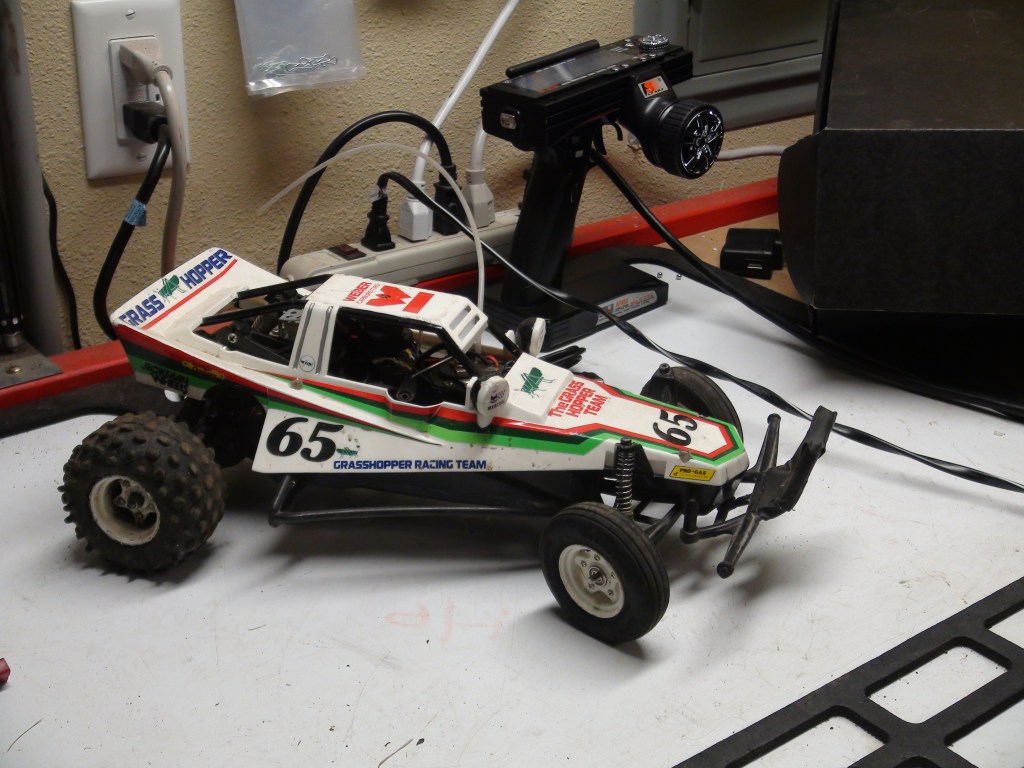
First things first—here it is, my Grasshopper with its original body from the early ‘80s. I honestly don’t even remember painting the whole thing red, nor where I managed to come up with the devil’s head stickers. When I first got the boxes out, I opened both of them and poked around a bit, and then decided I would restore the Grasshopper first to figure out how the landscape had changed since I had last actively worked on my RCs.

So, the first thing to do was start researching. Many of the articles I’ve written on this blog cover the topics I had to dig through back then, and frankly, I wish I’d had a condensed version. So if you’ve been following along and wondered what all this old drivel is about, well, it’s for that next person coming along who’s trying to break into it from the ancient past:
- “From FM Crystals to 2.5GHz: The Evolution of RC Radio Technology”
- “Battery Basics: NiCd to NiMH to iPo and Other Stops Along the Way”
- “From Mechanical to Electronic Speed Controllers: A Technological Evolution in RC”
Assessing the Grasshopper’s Condition
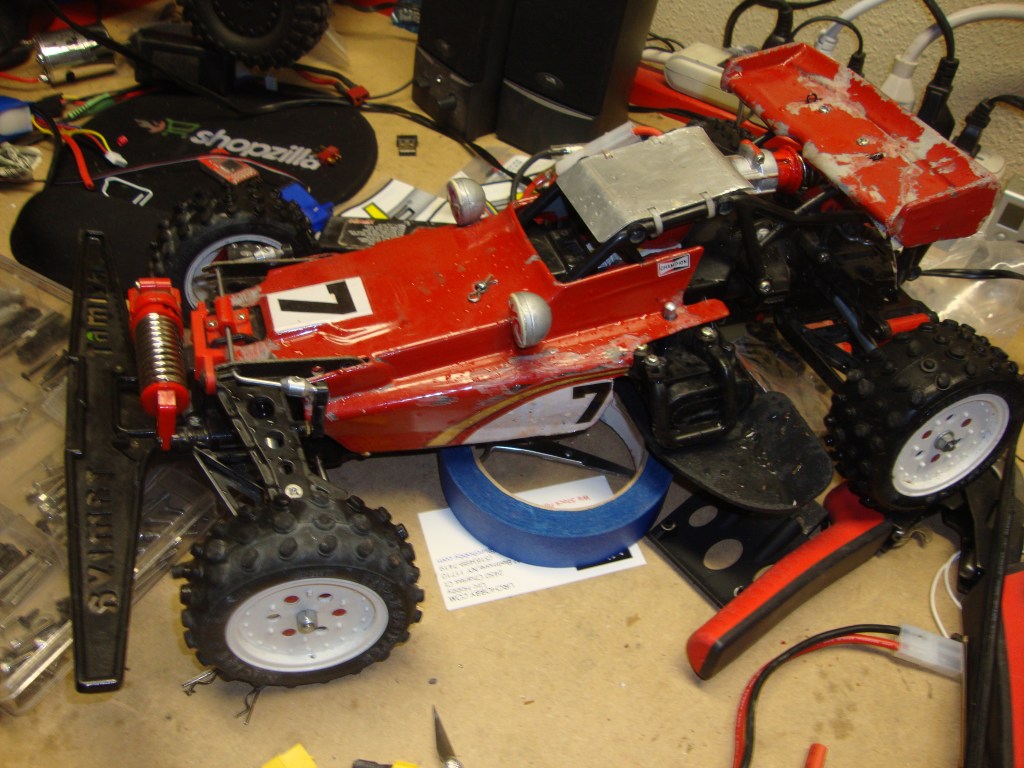
When I first pulled the Grasshopper out of its box, the wave of nostalgia was almost overwhelming. However, as I inspected the car, it became clear just how much wear and tear these vehicles had endured over the years. A large chip was missing from the tail fin of the Grasshopper, and the back of the Hotshot had been packed with epoxy in a desperate attempt to keep it together. Clearly, I hadn’t been easy on them back in the day. Yet, despite the rough treatment and two decades of storage, both cars had weathered the years remarkably well. The paint, though scratched and chipped from heavy use, had held up decently, and those devil’s head decals—faint memories of a younger me—were peeling at the edges but still clinging on. The tires, surprisingly, were still malleable, though the knobbies had worn down to near-baldness from countless runs.
The first order of business was to see if the old Grasshopper would still run. This turned out to be more complicated than I anticipated. Back when I’d put everything away 20 years earlier, I hadn’t exactly planned for a two-decade hiatus. The AA batteries inside my Futaba radio had long since burst, leaving a corroded mess behind. It took considerable effort to clean up the radio and get it back in shape to accept a fresh set of eight AAs. With some relief, I powered it on—and it worked.
Next up was the battery. I had a classic 7.2V Tamiya NiCd battery with a massive (for the time) 1200mAh capacity. I dusted off my old charger, a high-performance model from that era, which charged at approximately 1 ampere. I did a quick calculation to determine how long I should leave the battery on the charger. Keep in mind, this was before the days of automatic cutoff features that we’re all spoiled by now.
Given that the charger outputs 1000mA, and the battery capacity was 1200mAh, the charging time was calculated as follows:

Factoring in some inefficiencies, I set a timer for 90 minutes. While waiting, I opened the rear axle, cleaned the gears, applied fresh grease, and cleared the dust out of the upgraded 540 motor I had installed years ago. The suspension was still in decent shape, though I hadn’t upgraded to oil-filled shocks back then.
When the timer went off, I eagerly inserted the battery into the Grasshopper and connected it to the speed controller. But when I turned it on…nothing. Disappointed but determined, I grabbed my multimeter to test the battery—something I should have done earlier. The battery was dead.
Resurrecting the Grasshopper
It was time for a trip to D’s Hobbies in Bend, Oregon. I was eager to get the Grasshopper running again, and they had a new 7.2V NiCd battery in stock. During my visit, I got caught up in a conversation about modern RC technology and learned about Central Oregon RC Rock Crawlers (CORCRC). I even started eyeing a new rock crawler—the Axial Wraith, which had been released the previous summer in 2011.
With the new battery charged and ready, I gave the Grasshopper another go. This time, it powered on. I opened the garage door and took it out for a run. Unfortunately, the results were disappointing—issues with the mechanical speed controller and unsteady handling. Back in the ‘80s, we used stick radios for control, and it wasn’t until the late ‘80s and early ‘90s that pistol-grip radios with steering wheels and throttle triggers took over. I was envious of what I had seen at D’s and decided it was time to invest a bit more.
Finishing the Grasshopper
Another trip to D’s Hobbies, and I picked up a new ESC, transmitter, and receiver. I wanted the modern steering wheel and trigger setup instead of the old sticks. This was my entry into the world of electronic speed controllers (ESC). Gone were the days of dirty contacts causing skips and three-speed settings through mechanical resistance. An ESC would bring smoother acceleration, precise control, and modern performance.
Since I was already making these upgrades, I decided to get an original body and restore it to the stock configuration and colors. I ordered a new Grasshopper body online, and luckily, thanks to Tamiya’s 2005 re-release of the Grasshopper, parts were readily available at reasonable prices.
After a few wrenching sessions, I had the new ESC installed, the new receiver in place, and bound with the new transmitter. The Grasshopper was ready to hit the road with all the latest tech under its 1983 shell. This time, it didn’t disappoint. The upgraded electronics and modern brushed motor brought my old Grasshopper to life, performing better than ever before. It was everything I remembered and more—a childhood dream, reimagined.
On to the Restoration of the Hotshot
Having learned a lot from getting the Grasshopper back into shape, I decided it was time to bring my beloved Tamiya Hotshot into the modern era as well. My work on the Grasshopper had taught me valuable lessons about integrating modern electronics into an older RC car, so I compiled a shopping list based on that experience:
- ESC and Brushed Motor
- Transmitter and Receiver
- Shock rings and oil
With all the new parts in hand and a few wrenching sessions later, I had the Hotshot up and running to the same standard as the Grasshopper. It was good, but it wasn’t quite there yet.
The Suspension Struggles
Despite replacing the shock rings and oil, the Hotshot’s suspension still wasn’t performing as I had hoped. The front end dragged constantly, and every bump sent the chassis scraping along the ground. This was a well-known issue with the Hotshot’s stock suspension system. While it was a groundbreaking car in its day, its suspension left a lot to be desired, particularly by today’s standards.
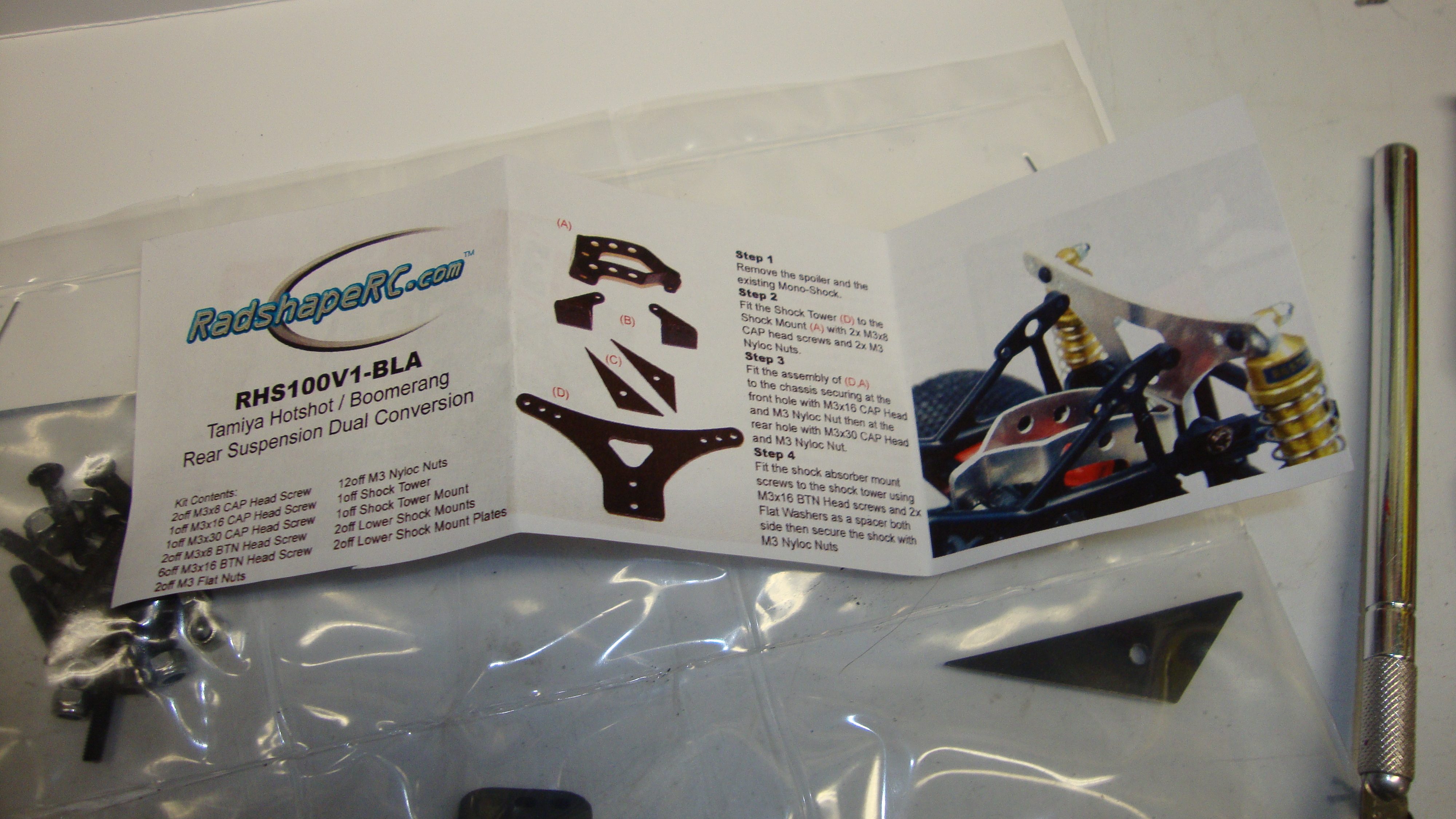
It was finally time to address the weak point that had been plaguing my Hotshot since the ’80s: the suspension. After doing some online research, I found a set of upgraded suspension kits from RadshapeRC.com (which, sadly, is no longer in operation). These kits promised a significant improvement in handling and durability. I wasted no time placing my order.
The Upgrade Process
When the kits arrived, I dove into the work. The upgrades included better dampers and stronger components designed to handle rougher terrain and provide a smoother ride. Installing the new parts was more involved than the work I had done on the Grasshopper, but it was immensely satisfying knowing that I was finally addressing one of the Hotshot’s most glaring weaknesses.
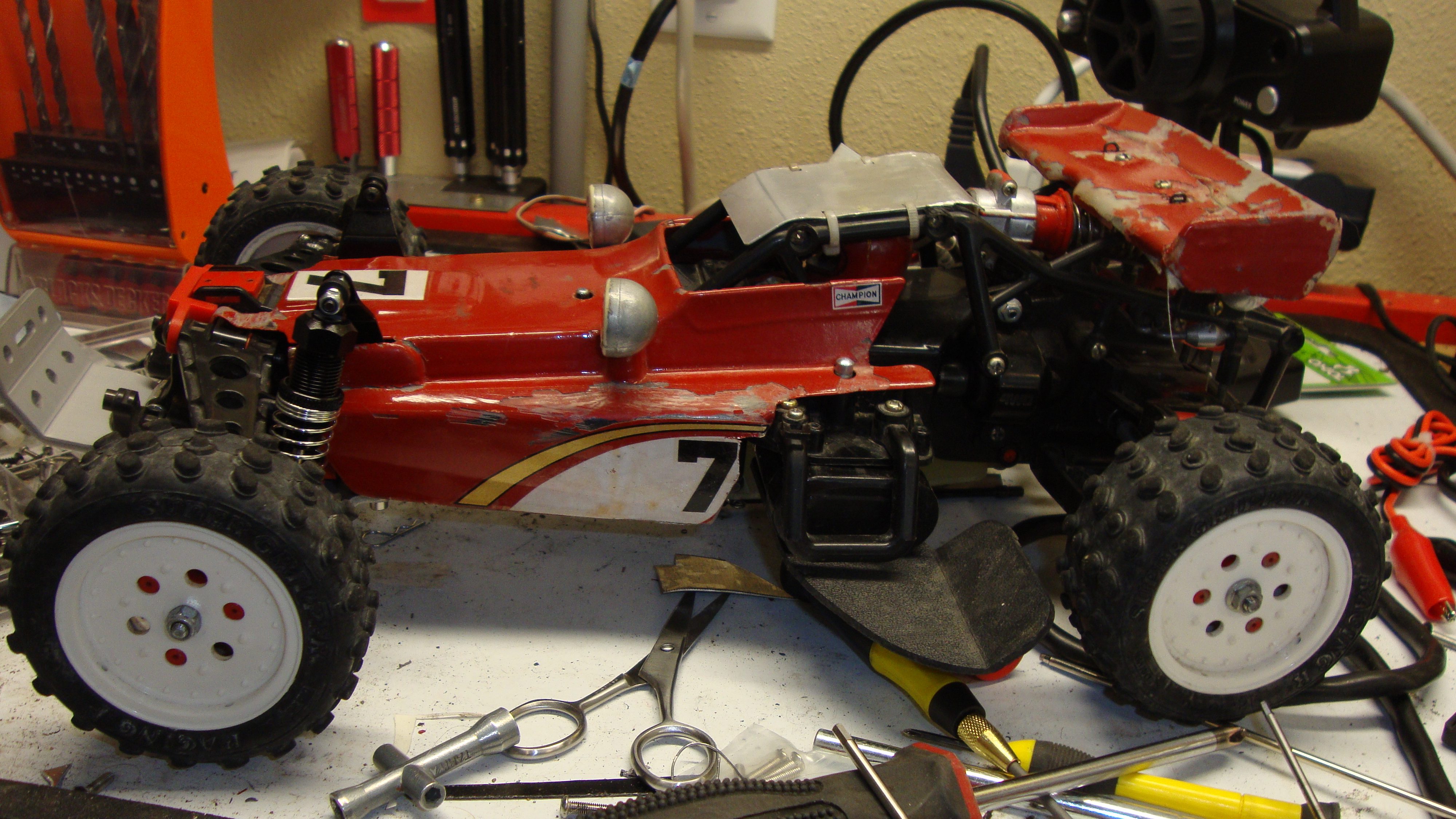
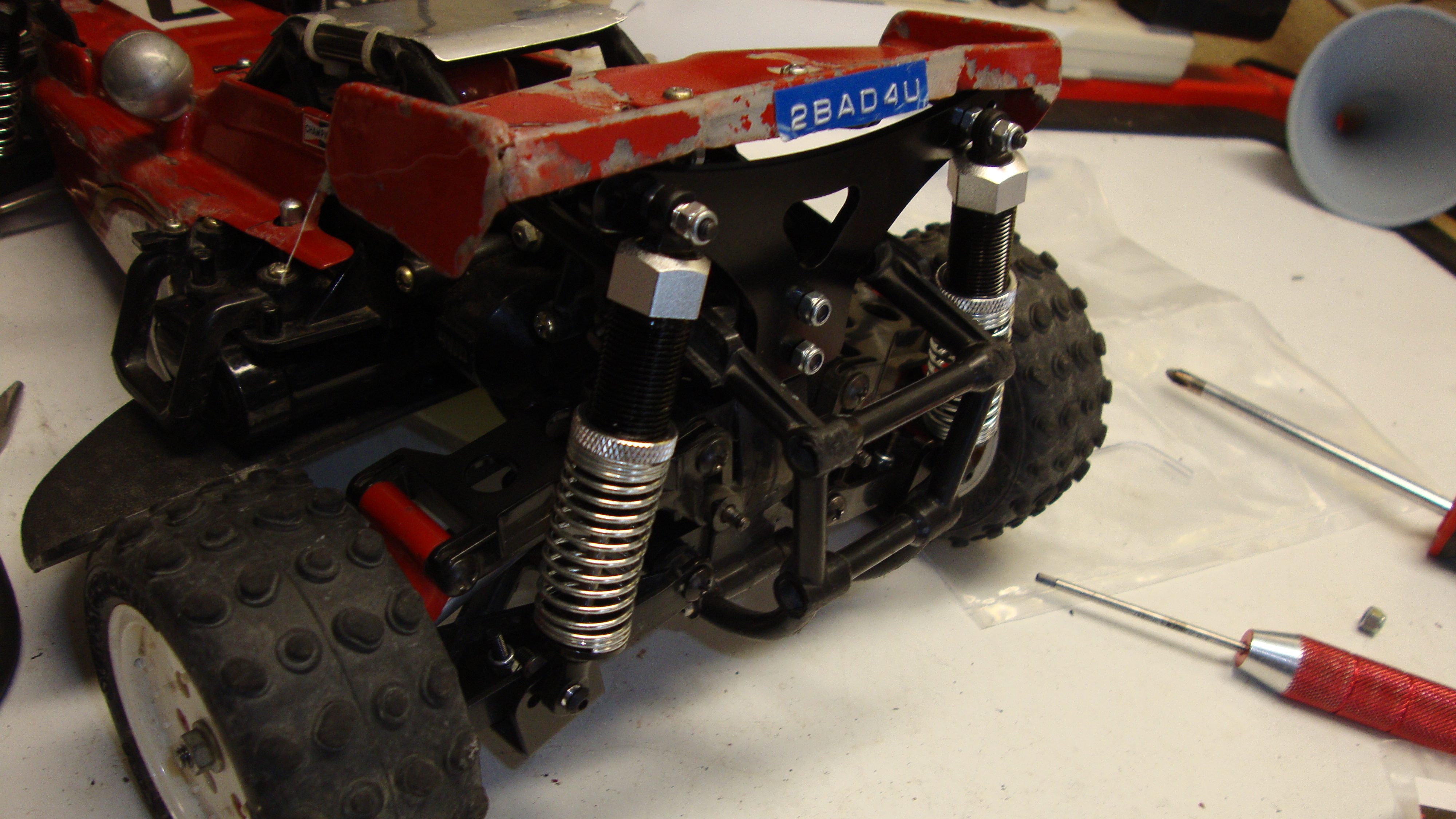
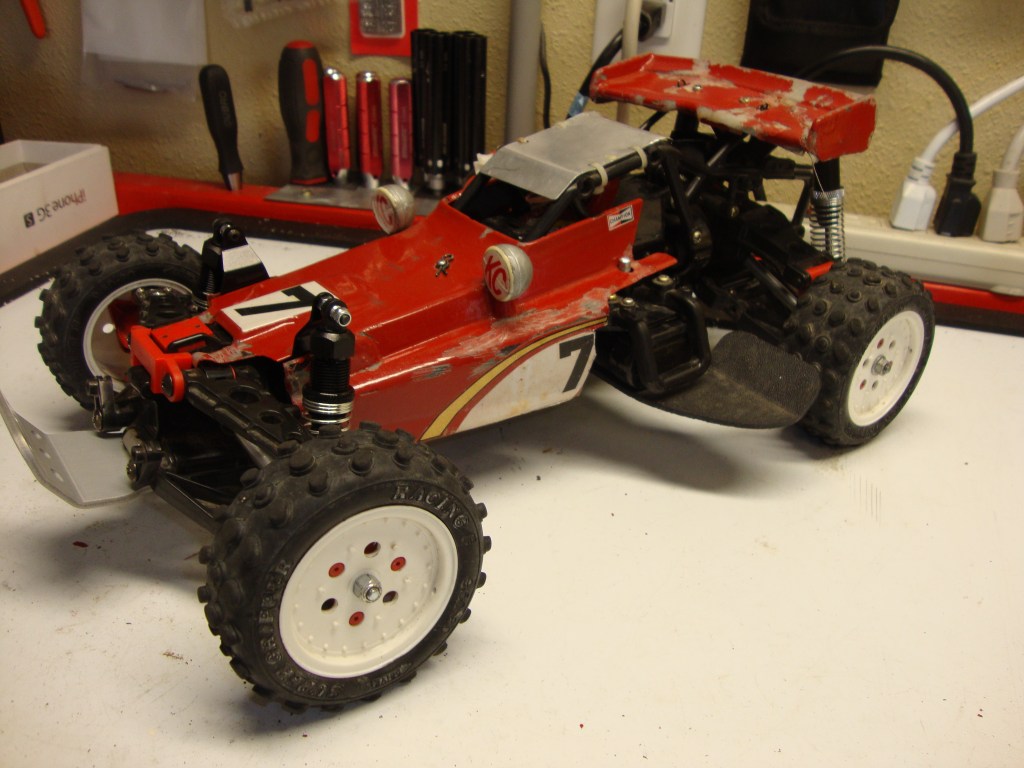
With the upgraded suspension in place, my Hotshot was no longer the fragile, ground-hugging buggy it once was. It could now tackle rough terrain confidently. The transformation was night and day—no more front-end scraping, and the car’s handling became far more predictable and responsive.
A New Era of RC Action
Before wrapping up this chapter of my RC journey, it’s only fitting to showcase the final results of the Grasshopper and Hotshot restorations. Back in March of 2012, I filmed a video capturing both cars in action, running in the alley behind my house on a makeshift ramp I crafted from cardboard. With two cameras on tripods, I tried my best to create some multi-shot magic, despite the simple setup. Watching these two iconic machines come back to life was immensely satisfying. It’s a testament to how far they’ve come—from dusty relics of my past to powerful, modernized buggies. Check out the video below to see the Grasshopper and Hotshot in all their restored glory.
Conclusion: A New Chapter Begins
Restoring both the Grasshopper and Hotshot was an incredible journey that not only reconnected me with my past but also reignited my love for RC cars. Bringing these classics back to life with modern technology gave me a deep appreciation for how far the hobby had come even by 2011. However, as satisfying as the process was, it became clear that while these nostalgic machines hold a special place in my heart, they simply couldn’t keep up with the modern advancements in RC performance.
Looking back now, nearly a decade later, I realize that this experience marked a turning point in my RC journey. While the Grasshopper and Hotshot paved the way for my return to the hobby, they also opened the door to the realization that newer, more powerful RC vehicles were calling my name. That realization, however, would take some time to evolve. I eventually found myself eyeing more modern machines—ones designed to handle the technological advancements of the time—but that’s a story for another post.
Keep an eye out for future reflections where I’ll recount my adventures diving into the world of modern RC cars and what it was like to add a brand-new, cutting-edge vehicle to my collection. That next chapter is coming soon enough.
— Coby R


 Rapid Rhino RC
Leave a comment